



If you still think the data center business is simply about building server rooms and renting racks, three numbers may change your mind completely.
The first number: RMB 380 billion. In 2025, Alibaba Cloud announced that it would invest more than RMB 380 billion in AI infrastructure over the following three years — more than its total capital expenditure over the previous five years combined. And Alibaba is not alone. ByteDance’s self-built intelligent computing centers in Ulanqab, Nantong and other locations have surpassed 1,000 MW in scale, while the three major Chinese telecom operators increased computing-related capital expenditure by more than 30% year on year in 2025.
The second number: 80.8%. By the first half of 2026, intelligent computing accounted for 80.8% of capacity across the eight East Data, West Computing hubs. In 2022, that figure was below 20%. In just four years, intelligent computing moved from the edge to the mainstream. Central and western China are no longer merely “warehouses” for compute — they are becoming genuine “compute factories.”
The third number: 21%. That was the year-on-year growth rate of China’s data center market in 2025. Over the same period, the global data center market exceeded USD 400 billion. China, with close to 15% of the global market, contributed more than 30% of incremental growth.
Taken together, those three numbers point to one conclusion: the computing industry is not experiencing a short cyclical upswing. It is going through a structural transformation.
But the window will not stay open forever.
First, supply is ramping up quickly. In the first half of 2025 alone, more than 60 intelligent computing centers were newly built or under construction in China — roughly one new project starting every three days. As capacity comes online, the market will move from shortage to balance, and then toward structural oversupply: high-end compute will remain scarce, while mid- and lower-tier capacity may face price competition. Data centers without meaningful differentiation will be squeezed by both commoditized competition and falling rental rates.
Second, demand is changing in structure. The old assumption that “if you build it, someone will rent it” is breaking down. Customers no longer want only racks, electricity and bandwidth; they want complete solutions capable of running large-model training and inference successfully. That is pushing data centers to evolve from infrastructure providers into computing-service providers — from selling space to selling capability. Companies that transform too slowly may be pushed out of the market.
Third, policy support is accelerating, but so are the requirements. More than 20 provinces and municipalities have introduced computing vouchers, the “computing power bank” concept has moved from theory into pilots, and the Ministry of Industry and Information Technology has begun building the “1+M+N” national computing interconnection system. The policy tailwind is unprecedented. At the same time, PUE requirements are becoming stricter, assessments of owned computing capacity more quantitative, and minimum shares of renewable electricity higher. Policy support now comes with harder conditions: collecting subsidies without delivering real capacity is no longer an option.
So how much longer will this golden window last?
A broad reading of current industry views suggests that the next 12 to 18 months will be the most critical period.
On one hand, the underlying demand for AI compute remains strong: AI capital expenditure by global technology leaders is expected to grow 35%–40% in 2026.
On the other hand, market consolidation has already begun, and the shift of resources toward leading players is unlikely to reverse. Companies that complete the transition from infrastructure provider to computing-service provider during this period will be better positioned to secure their place in the market over the next three to five years.
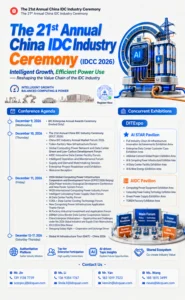
On December 10–11 in Beijing, DITExpo 2026, the Digital Infrastructure Technology Expo, will focus on the defining issues of this window. Held concurrently, the 21st Annual China IDC Industry Conference (IDCC 2026) will bring together more than 100 experts and industry leaders for in-depth discussion of key topics including 10,000-GPU clusters, computing-power coordination and domestic computing substitution. If you work in this sector, this is one industry gathering worth putting on the calendar.
Discussion: How long do you think the critical window will remain open?
Share your view — and your reasoning — in the comments. Let’s compare perspectives.